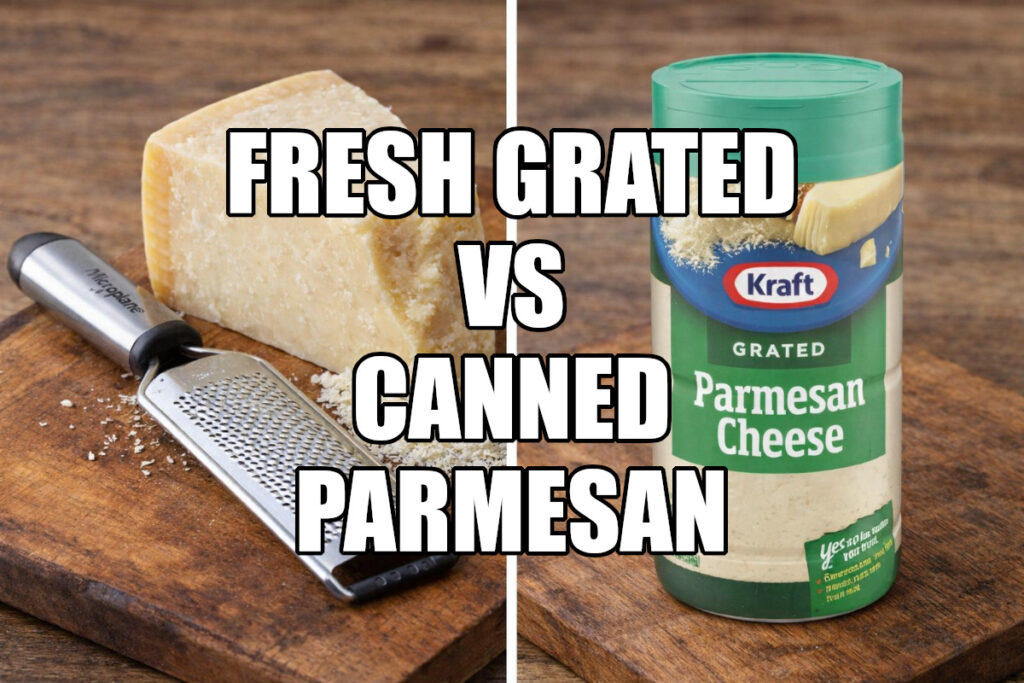
You’re standing in the grocery store cheese aisle, stuck between a $4 green can that’s been in every American kitchen since the 1950s and a $12 wedge of something called Parmigiano Reggiano. The green can is what your mom shook on spaghetti night. The wedge is what every cooking show says you “should” be using.
Here’s the thing: I’m not here to shame anyone’s cheese choices. I grew up with that green can on the table, and honestly, there’s a certain nostalgia to it. But after years of cooking and testing recipes, I’ve learned there’s a massive difference between the two, and understanding what you’re actually buying will help you make better choices in the kitchen.
This isn’t about being a food snob. It’s about knowing when fresh parmesan matters and when you can get away with the convenient stuff. Spoiler alert: there ARE legitimate uses for both, but probably not what you think.
Let’s break down what you’re actually getting with each option.
What You’re Actually Buying
The Green Can Reality Check
Let’s start by looking at what’s actually in that iconic Kraft canister. Pull one off the shelf and check the ingredients:
- Parmesan cheese (pasteurized part-skim milk, cheese culture, salt, enzymes)
- Cellulose powder (to prevent caking)
- Potassium sorbate (to protect flavor)
That middle ingredient is where things get interesting.
What cellulose actually is: It’s a plant-based fiber derived from wood pulp. Yes, the same stuff that’s in paper. Before you panic, it’s FDA-approved and not harmful to eat. It’s basically non-digestible plant fiber, which your body just passes through.
But here’s what matters for cooking: cellulose can make up anywhere from 3% to nearly 9% of the content in some brands. You’re not buying 100% cheese, you’re buying cheese mixed with wood pulp filler. The cellulose serves two purposes: it keeps the powdered cheese from clumping, and it’s way cheaper than actual cheese.
This became a huge scandal back in 2012 when the FDA investigated Castle Cheese Inc., a Pennsylvania company that was caught cutting its “100% real Parmesan” with not just cellulose, but also cheaper cheeses like cheddar, Swiss, and mozzarella. Bloomberg investigated other brands and found cellulose percentages ranging from 0.3% to 8.8%.
The aging factor: In the United States, parmesan cheese only needs to be aged for 10 months minimum. Most canned parmesan hits that bare minimum, then gets dried and powdered for shelf stability. Compare that to authentic Parmigiano Reggiano, which must be aged at least 12 months and is typically aged 24-36 months.
Why it doesn’t need refrigeration: The combination of preservatives and extremely low moisture content means canned parmesan is essentially “dead” cheese. It won’t develop any further flavor, it won’t grow mold easily, and it can sit in your pantry indefinitely. The label says to refrigerate after opening, but let’s be honest, most people don’t, and it’s fine for months.
Fresh Grated Parmesan (What “Fresh” Actually Means)
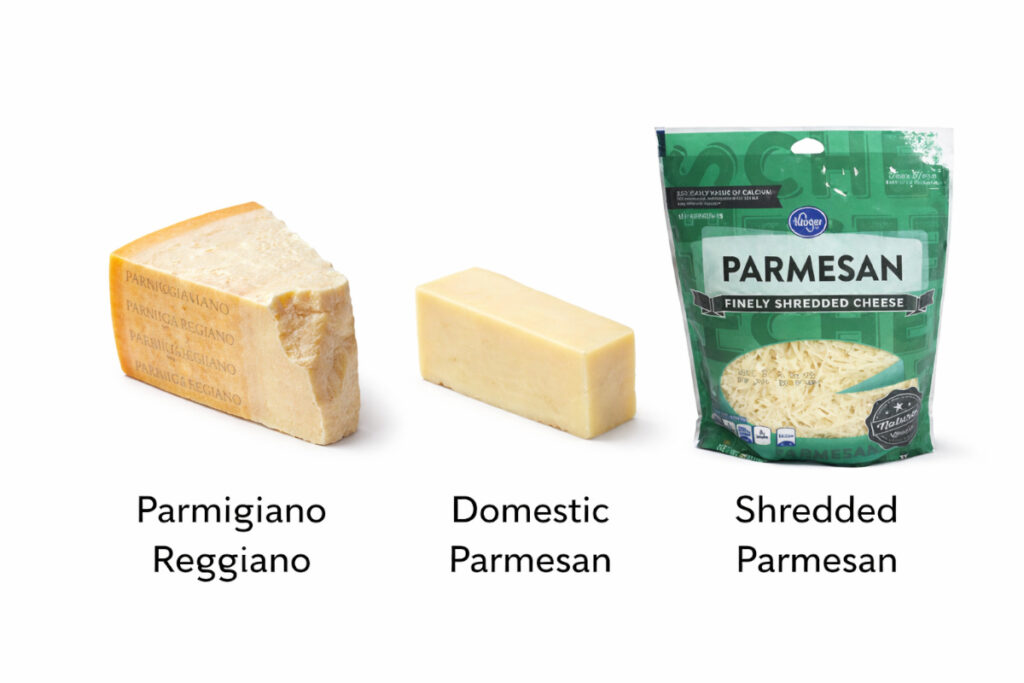
When we talk about “fresh” parmesan, there are actually three different levels:
1. Parmigiano Reggiano (The Real Deal)
This is the authentic Italian cheese that has Protected Designation of Origin (DOP) status in the European Union. To legally be called Parmigiano Reggiano, it must:
- Come from specific regions in Italy (Parma, Reggio Emilia, Modena, Bologna, or Mantua)
- Be made with unpasteurized cow’s milk from the region
- Contain only three ingredients: milk, salt, and rennet
- Be aged a minimum of 12 months (typically 24-36 months)
- Meet strict quality inspections
You’ll recognize authentic Parmigiano Reggiano by the pin-prick dots embedded all over the rind and the name stamped repeatedly around the wheel. Price: $15-20 per pound.
2. Domestic Parmesan Block
This is parmesan-style cheese made in the United States (or other countries) following similar methods but without the geographical restrictions. It’s:
- Made with pasteurized milk
- Aged for shorter periods (typically 10-12 months)
- Contains no additives when you buy the block
- Made anywhere in the world
The quality can vary significantly between producers, but a good domestic parmesan block is still real cheese with no fillers. Price: $8-12 per pound.
3. Store-Grated Fresh Parmesan
This is the pre-grated stuff you find in the refrigerated section of the grocery store, usually in clear plastic containers in the deli area. It’s:
- Freshly grated from actual blocks of parmesan at the store
- Usually contains a small amount of cornstarch or potato starch to prevent clumping
- Still 100% cheese (or very close to it)
- More convenient but degrades faster once grated
Price: $10-15 per pound.
The Taste Test Nobody Wants to Admit
Here’s where we get to the uncomfortable truth that cheese snobs don’t want to acknowledge: taste is partially about what you grew up with.
Flavor Comparison
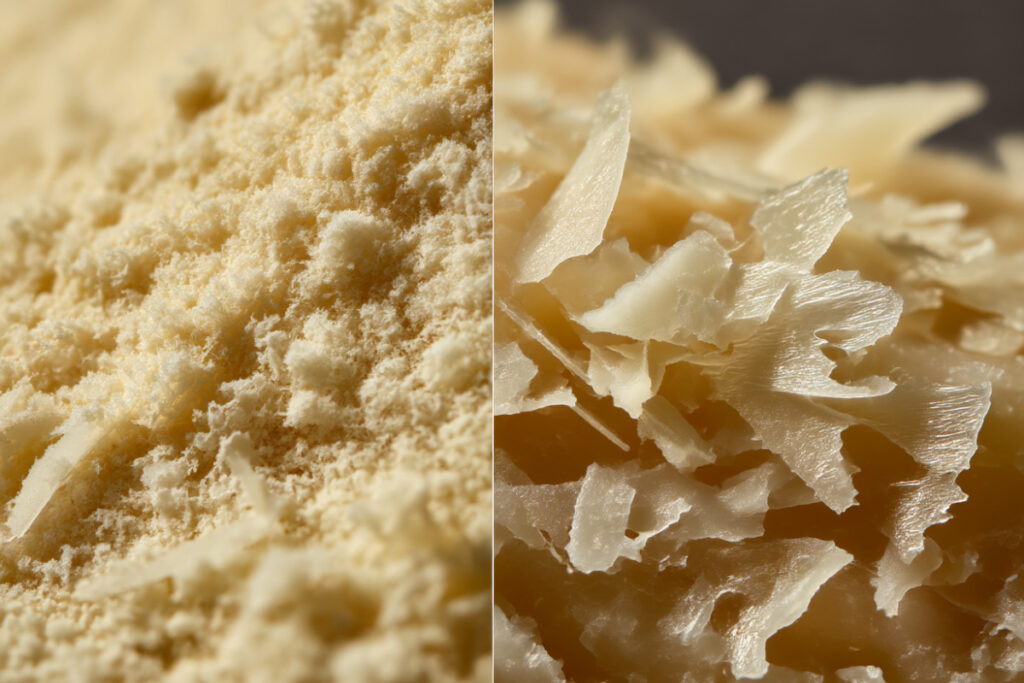
Canned parmesan tastes like:
- Powdery and dry in texture
- One-dimensionally salty
- Has a “lingering” quality on your tongue (it doesn’t melt in your mouth)
- Frankly, it tastes like nostalgia for a lot of people
- Lacks the complexity and nutty notes of aged cheese
Fresh block parmesan tastes like:
- Literally melts in your mouth
- Complex flavor profile: nutty, slightly fruity, deeply umami-rich
- Has a crystalline texture (those little crunchy bits you feel are actually concentrated flavor crystals called tyrosine)
- You can taste the aging process
- More “alive” flavor
The nostalgia factor is real: If you grew up with that green can on the dinner table every spaghetti night, your brain associates that specific flavor with “good pasta.” There’s nothing wrong with that. Many people genuinely prefer the taste of canned parmesan because it’s what they know. But it’s important to understand that you’re choosing familiarity, not necessarily better flavor.
I’ll be honest: when I taste-tested these side by side, the canned stuff tasted flat and salty compared to fresh parmesan, which had layers of flavor I never noticed before. But I also understand that for some people, fresh parmesan tastes “wrong” because it’s not what they expect.
Texture Differences (And Why It Matters)
This is where the rubber meets the road for cooking.
Why canned parmesan doesn’t melt properly:
Remember that cellulose we talked about? It’s specifically designed to NOT clump or melt. That means when you add canned parmesan to a sauce, it doesn’t incorporate smoothly. Instead, you get:
- A grainy, gritty texture in sauces
- Cheese that sits on top rather than melting in
- A powdery coating rather than a creamy element
- Dishes that can feel dry or chalky
This makes canned parmesan terrible for recipes like alfredo, carbonara, or risotto, where the cheese needs to create a creamy sauce.
Fresh parmesan melts beautifully:
When you add freshly grated parmesan to hot pasta or a sauce:
- It melts and creates a creamy, silky texture
- The cheese integrates fully into the dish
- You get that classic Italian pasta coating
- The fat in the cheese emulsifies with pasta water or cream
This is why every Italian grandmother will tell you that fresh parmesan is non-negotiable for traditional dishes.
When to Use Each (The Honest Truth)
Okay, let’s get practical. Here’s when each type actually makes sense.
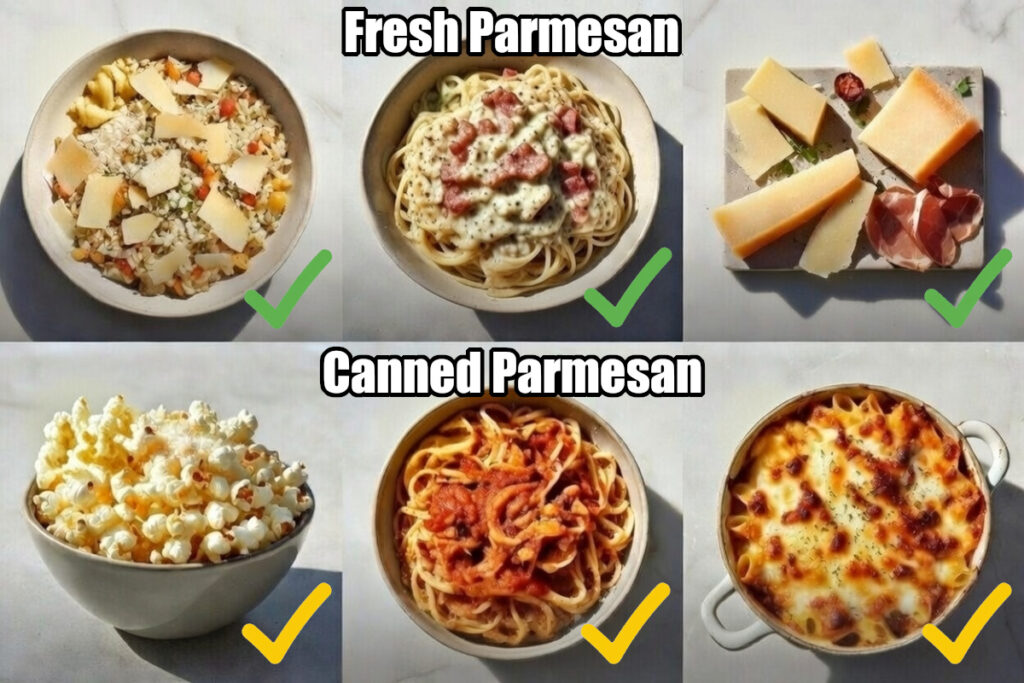
When Canned Actually Works
I’m going to defend the green can here, because there ARE legitimate uses:
1. Popcorn seasoning The powdery texture that makes it terrible in sauces actually works great on popcorn. It sticks to the kernels and distributes evenly. This is honestly one of the best uses for canned parmesan.
2. Emergency pantry ingredient If you rarely use parmesan and don’t want a block going moldy in your fridge, keeping a can in the pantry makes sense. It lasts forever and is there when you need it.
3. Camping and RV cooking No refrigeration needed, lightweight, won’t spoil. Perfect for outdoor cooking where you can’t bring fresh cheese.
4. Large batch cooking where flavor gets buried Making a huge pot of chili or a massive casserole where parmesan is just one of many flavors? The difference between fresh and canned probably won’t be noticeable.
5. When you’re broke and feeding kids Real talk: if you’re stretching a budget and the kids just want “cheese on pasta,” canned parmesan is fine. Feed your family. Don’t let food snobs make you feel bad about it.
6. Nostalgia dishes If your comfort food version of spaghetti specifically requires that green can flavor, use it. Food is about more than nutrition; it’s about comfort and memories too.
What Canned DOESN’T Work For
Here’s where canned parmesan will genuinely ruin your dish:
Any recipe where parmesan is a primary ingredient:
- Risotto (the cheese creates the creaminess)
- Alfredo sauce (you need real cheese to emulsify)
- Carbonara (traditional recipe relies on cheese melting with egg)
- Cacio e pepe (literally “cheese and pepper” pasta)
- Caesar salad dressing (flavor matters here)
Topping finished pasta dishes: If you’re sprinkling cheese on top of beautifully cooked pasta as a finishing touch, use fresh. The texture and flavor difference is night and day.
Cheese boards: This should be obvious, but I’ve seen people try. Don’t serve canned parmesan at a party unless it’s a very specific, ironic choice.
Any recipe from serious cooking sites: If Serious Eats, America’s Test Kitchen, or any Italian cooking blog specifies parmesan, they mean fresh. The recipe was tested with fresh cheese, and results will differ with canned.
When Fresh Is Non-Negotiable
1. Italian recipes where cheese is the star Dishes like cacio e pepe or carbonara literally depend on the cheese behaving a certain way. Canned parmesan won’t work.
2. Risotto The creamy texture of risotto comes from the starch in arborio rice plus the fat and protein in parmesan melting together. Canned cheese can’t do this.
3. Caesar dressing When parmesan is one of the main flavors, you want real cheese. The dressing will taste dramatically better with fresh.
4. Finishing pasta dishes If you’re going to see and taste the cheese on top of your pasta, use fresh. The visual appeal and flavor are worth it.
5. Cheese boards Obviously. You’re eating the cheese as cheese, not as an ingredient.
6. Soups where you want depth Tossing a parmesan rind into minestrone or chicken soup adds incredible depth. You can’t do this with canned cheese.
7. When you’re trying to impress Cooking for a date, hosting a dinner party, or making something special? Fresh parmesan shows you care about quality.
Cost Analysis (The Real Math)
Let’s do the actual math, because the price difference isn’t as dramatic as you might think.
Price Breakdown
- Kraft green can (8 oz): About $4, which works out to $8 per pound
- Domestic parmesan block: $8-12 per pound
- Parmigiano Reggiano: $15-20 per pound
At first glance, the green can looks cheaper. But here’s what that price doesn’t tell you:
Hidden costs of canned:
- You’re paying for 3-9% cellulose (wood pulp filler), not cheese
- The actual cheese content is less than advertised
- The flavor is weaker, so you need to use more to get the same impact
True value of fresh:
- 100% cheese, no fillers
- Stronger flavor means you use less
- A properly stored block lasts 6 months in the fridge
- You can freeze grated parmesan for up to a year
Usage reality:
In my testing, I found that I used about 1/4 cup of canned parmesan to get similar flavor to 2-3 tablespoons of fresh. When you factor in that you need more canned cheese to achieve comparable flavor, the cost per actual cheese content is surprisingly close.
A $10 wedge of domestic parmesan (about 1 pound) will last a casual parmesan user several months. That same $10 spread over months of cooking isn’t really breaking the budget.
The Middle Ground: Refrigerated Pre-Grated
There’s a third option that doesn’t get talked about enough: the pre-grated fresh parmesan you find in plastic containers in the refrigerated section.
Store-Grated Fresh Parmesan
Pros:
- Convenience of pre-grated without the quality compromise
- Usually grated recently at busy stores
- Still 100% cheese (might have cornstarch to prevent clumping)
- No cellulose or preservatives
- Closer to fresh-grated in flavor and texture
Cons:
- More expensive than buying a block
- Degrades faster once grated (more surface area exposed to air)
- Quality varies depending on store turnover
- Not quite as good as fresh-grating yourself
Best practices if you go this route:
- Buy from stores with high turnover. Whole Foods, Trader Joe’s, and busy supermarkets grate cheese more frequently than small stores.
- Check the date. Look for the freshest package available.
- Taste before buying. Most stores will let you sample from the deli section.
- Use within 2 weeks. After opening, quality drops off quickly.
This is a solid compromise if you want real cheese flavor but can’t be bothered with the grating. It’s what I keep on hand for weeknight cooking when I don’t want to break out the grater.
Storage and Shelf Life
Proper storage makes a huge difference in how long your cheese lasts and how good it tastes.
Fresh Parmesan Block
How to store it:
- Wrap the cheese in parchment paper or wax paper first
- Then wrap that in plastic wrap, foil, or place in a beeswax wrap
- Store in the cheese drawer or the warmest part of your fridge (usually the door)
- Never store in plastic alone, it makes the cheese sweat
How long it lasts:
- Properly wrapped in the fridge: 6 months
- You can freeze grated parmesan in portions: up to 1 year
- If you see a little mold on the edges, just cut it off and use the rest
Pro tip for convenience: Buy a large wedge when it’s on sale, grate the entire thing in a food processor, and freeze it in 1-cup portions in mason jars. Pull from the freezer as needed. This gives you the convenience of pre-grated with the quality of fresh, and it’s cheaper than buying either canned or store-grated.
Canned Parmesan
How to store it:
- Shelf-stable until opened (pantry is fine)
- After opening, the label says refrigerate, but most people keep it in the pantry
- It’ll last months either way because of the preservatives
Honestly: The shelf stability is one of the genuine advantages of canned parmesan. If you use it rarely, it’s nice to have something that won’t go bad.
How to Grate Fresh Parmesan
If you’re switching to fresh parmesan, here’s how to grate it efficiently.
Three Methods
1. Microplane grater (my go-to for everyday use)
- Creates fine, fluffy, snow-like shreds
- Perfect for topping pasta
- Easy to clean
- Works great at the table (grate fresh over each plate)
- Best for small amounts
2. Box grater (for bigger shreds)
- Use the medium or large holes
- Creates shreds good for mixing into dishes
- Takes more effort
- Harder to clean
3. Food processor (for batch grating)
- Cut parmesan into 1-inch chunks
- Pulse until desired consistency
- Perfect for grating a whole block at once
- Freeze portions in mason jars
- Saves time and money
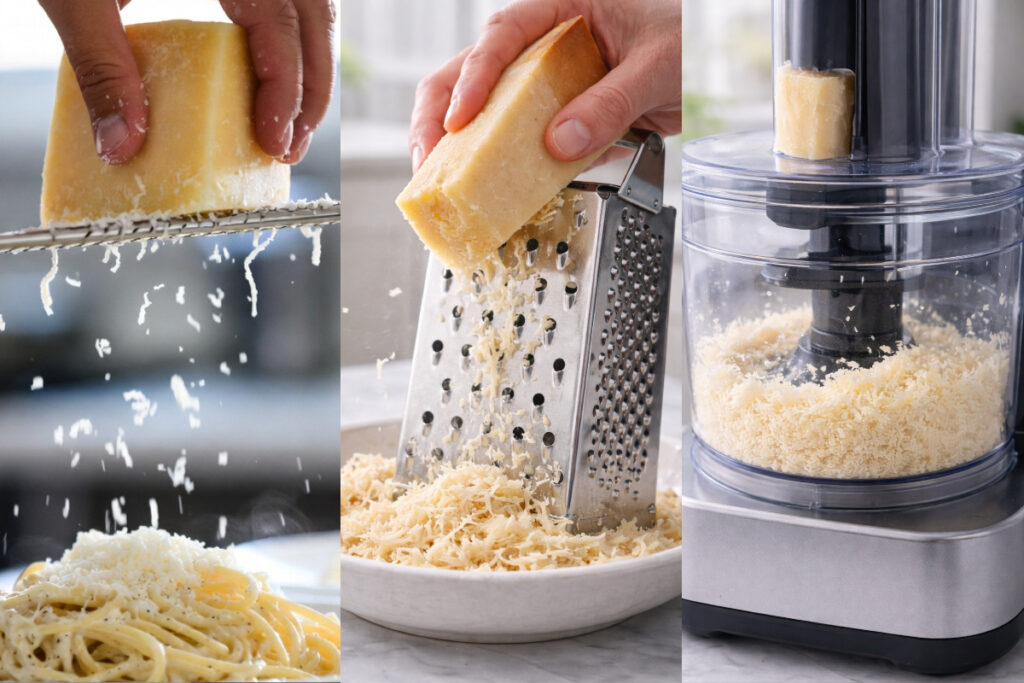
My weekly routine: Every Sunday, I grate about 2 cups of parmesan in the food processor and store it in a mason jar in the fridge. It takes 5 minutes and gives me fresh-grated convenience all week. When I want extra-fresh, I’ll use the microplane at the table.
The Parmigiano Reggiano Question
Okay, so we’ve established that fresh parmesan is better than canned. But what about the premium stuff? Is authentic Parmigiano Reggiano worth paying double the price?
When It Actually Matters
The premium is worth it when:
- You’re eating the cheese solo or on a cheese board. If you’re tasting the cheese as cheese, the complex flavor of aged Parmigiano Reggiano is incredible. You can actually taste the difference between 24-month and 36-month aging.
- Simple pasta dishes where it’s the star. In a dish like cacio e pepe, where there are only three ingredients (pasta, cheese, pepper), the quality of the cheese is everything.
- You can actually taste the difference. Some people have more sensitive palates and genuinely appreciate the complexity. Others can’t tell much difference.
When It Doesn’t Matter As Much
Save your money when:
- The cheese is mixed into complex sauces. If you’re making a tomato-based sauce with garlic, basil, oregano, and meat, the subtle differences in the cheese get lost.
- It’s going into baked dishes. The high heat of baking can diminish some of the complex flavors you’re paying extra for.
- It’s combined with strong flavors. Mixing it with sharp flavors like hot peppers, strong herbs, or acidic ingredients makes the premium less noticeable.
The Sweet Spot
Here’s my practical recommendation:
- Keep a domestic parmesan block ($8-12/lb) for everyday cooking
- Buy Parmigiano Reggiano ($15-20/lb) for special occasions, cheese boards, and simple dishes where you’ll taste the difference
- Keep canned for camping, emergencies, or if it’s what you genuinely prefer
This strategy gives you flexibility without breaking the bank.
Reading the Label (What to Look For)
Not all cheese marketing is honest. Here’s how to decode what you’re buying.
Red Flags on Canned Parmesan
“100% Grated” doesn’t mean 100% cheese. It just means it’s 100% grated (as opposed to shredded or chunked). The word order matters. If it says “100% Grated Parmesan Cheese,” that’s different from “100% Parmesan Cheese, Grated.”
Look for:
- Cellulose powder listed in ingredients
- Multiple preservatives
- “Parmesan product” instead of “Parmesan cheese”
- Vague aging claims or no aging mentioned
What Good Parmesan Labels Say
For authentic Parmigiano Reggiano:
- Says “Parmigiano Reggiano” with DOP certification
- Pin-prick dots visible on the rind
- Rind stamped with “Parmigiano Reggiano” repeatedly
- Ingredients: milk, salt, rennet (that’s it)
- Aged 12+ months (label should state specific aging)
For domestic parmesan:
- Clear “parmesan cheese” labeling
- Simple ingredient list (milk, cultures, salt, enzymes)
- Aging time mentioned (look for 12+ months if possible)
- No cellulose or anti-caking agents (if it’s a block)
The Verdict
Let’s wrap this up with the bottom line.
What We Learned
Fresh parmesan wins on virtually every measure: flavor, texture, cooking performance, nutritional value (it’s 100% cheese), and versatility. If you care about how your food tastes and you have the budget flexibility, fresh parmesan is objectively better.
Canned parmesan has its place, but that place is limited. It works for popcorn, camping, emergencies, and situations where convenience trumps quality. It’s also fine if nostalgia is what you’re after, or if budget constraints make it the practical choice.
Store-grated fresh parmesan is a decent middle ground. You get most of the benefits of fresh cheese with the convenience of pre-grated. It’s more expensive than buying a block, but less work.
The price difference is smaller than you think when you factor in that you use less fresh parmesan to achieve better flavor, and properly stored fresh parmesan lasts for months.
Smart Strategy for Real Kitchens
Here’s what I actually do in my kitchen:
- Keep a block of domestic parmesan in the fridge wrapped in parchment and wax paper. This is my everyday cooking cheese. I grate a bunch every Sunday and keep it in a mason jar.
- Buy Parmigiano Reggiano occasionally when it’s on sale or for special dishes where I’ll really taste the difference. A little goes a long way.
- Keep a can in the pantry for true emergencies or camping trips. I’m not going to pretend it doesn’t exist.
- Freeze excess grated cheese in portions so nothing goes to waste and I always have fresh-grated convenience.
This approach gives me the quality I want for dishes where it matters, the convenience I need for busy weeknights, and the flexibility to choose based on what I’m cooking.
Final Word
You’re not a food snob for wanting actual cheese in your cheese. The difference between fresh parmesan and the canned stuff is real, measurable, and noticeable in most dishes.
But you’re also not doing it wrong if canned parmesan works for your life, your budget, or your taste preferences. Food is personal. Nostalgia is valid. Convenience matters. Budget constraints are real.
The goal here isn’t to make you feel bad about the green can. The goal is to give you the information to make an informed choice. Now you know what you’re buying, what the real differences are, and when each option makes sense.
Use that knowledge however works best for your kitchen.
Frequently Asked Questions
Q: Can you use canned parmesan instead of fresh in recipes?
A: You can, but your results will be different. Canned parmesan works okay in cooked dishes where it’s mixed with other strong flavors, but it won’t melt properly for creamy sauces and lacks the complex flavor for topping finished dishes. For dishes like risotto, carbonara, or alfredo, fresh parmesan is essential.
Q: Why is canned parmesan so much cheaper?
A: Canned parmesan contains cellulose (up to 9% wood pulp) as filler, is aged for less time (10 months vs 12-36 months for quality parmesan), and is made from lower-grade cheese. You’re paying less because you’re getting less actual cheese and more filler.
Q: Does canned parmesan need to be refrigerated?
A: Before opening, no. The preservatives (potassium sorbate) and extremely low moisture content make it shelf-stable. After opening, the label recommends refrigeration for best quality, though it won’t spoil quickly due to the preservatives. Most people keep it in the pantry and it stays fine for months.
Q: How long does fresh parmesan last in the refrigerator?
A: A properly wrapped block of parmesan lasts about 6 months in the refrigerator. Wrap it in parchment or wax paper first, then in plastic wrap or foil. Store it in the cheese drawer or door of your fridge. You can also freeze grated parmesan for up to 1 year.
Q: What is cellulose in parmesan cheese and is it safe?
A: Cellulose is plant-based fiber derived from wood pulp, used as an anti-caking agent in grated parmesan. It’s FDA-approved and safe to eat (your body doesn’t digest it, it just passes through). However, it prevents the cheese from melting properly and adds no nutritional value or flavor. It’s essentially cheap filler.
Q: Is Parmigiano Reggiano worth the extra cost?
A: It depends on how you’re using it. For cheese boards, simple pasta dishes where cheese is the star, or eating the cheese on its own, yes, the complex flavor is worth it. For dishes with many ingredients or strong flavors where the cheese gets buried, domestic parmesan works fine and saves money.
Q: Can you freeze parmesan cheese?
A: Yes. Grated parmesan freezes excellently for up to 1 year. I recommend grating an entire block in the food processor and freezing it in 1-cup portions in mason jars. You can also freeze the block whole, though the texture becomes more crumbly when thawed (which is fine for grating).
Q: What’s the difference between shredded and grated parmesan?
A: Grated parmesan is finely ground into a powder-like consistency (what you get from a microplane or in the green can). Shredded parmesan has larger, visible pieces (from a box grater). Grated works better for topping dishes and melting into sauces, while shredded is better for mixing into dishes or where you want visible cheese pieces.