You’ve eaten béchamel sauce dozens of times, even if you didn’t know what it was called. It’s the creamy layer in lasagna. It’s what makes mac and cheese smooth instead of grainy. It’s the base of a good gravy and the secret behind creamy casseroles that hold together instead of turning into a soupy mess.
Béchamel is one of the five French mother sauces, which sounds fancy until you realize it’s just butter, flour, and milk. That’s it. Three ingredients you already have, about 15 minutes of your time, and you’ve got a kitchen fundamental that opens up a world of possibilities.
The Ratio to Remember
Here’s the formula: 1 ounce butter + 1 ounce flour + 1 1/4 cups milk = thick, creamy, velvety sauce.
Memorize that and you can scale it up or down for whatever you’re making without pulling up a recipe. Need more for a big lasagna? Double it. Just want enough for a quick pasta dish? Cut it in half.
Key Ingredients
Unsalted butter gives you control over the final flavor. If you only have salted butter, skip the added salt at the end and season to taste.
All-purpose flour is the thickening agent. Cooking it in the butter first (that’s your roux) gets rid of the raw flour taste and helps it disperse evenly in the milk without clumping.
Whole milk delivers the richness you want. Low-fat works if that’s what you have, but the sauce will be thinner. Heavy cream goes the other direction and makes it richer.
How It Works
The process is simple, but technique matters.
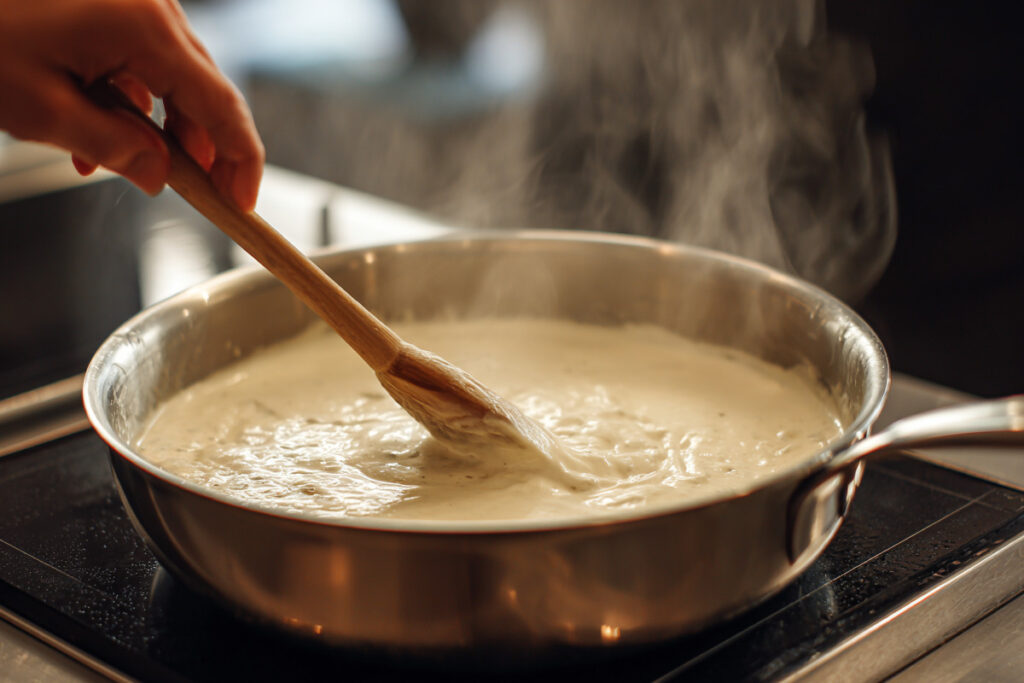
First, you make a roux by melting butter and whisking in flour. Cook this for a few minutes until it smells nutty rather than floury and looks like wet sand. Don’t let it brown for béchamel.
Then pour in cold milk all at once. There’s a lot of debate about whether the milk should be warm or cold. Cold works fine and actually gives the roux more time to disperse before the sauce starts thickening, which helps prevent lumps.
Whisk constantly as it comes to a simmer. You’ll know it’s ready when you can dip a spoon in, run your finger across the back, and the sauce holds that line instead of running back together.
Season at the end. Salt and pepper at minimum. A pinch of nutmeg is traditional and adds a subtle warmth that makes people wonder what your secret is.
Fixing Common Problems
Béchamel is forgiving if you know how to rescue it.
Sauce too thin? Keep cooking it down, or whisk in a slurry of flour and milk. It also thickens as it cools, so give it a minute before panicking.
Sauce too thick? Whisk in more milk until you hit the consistency you want.
Lumps? It happens. An immersion blender fixes lumpy sauce fast.
What to Make With It
Once you’ve got béchamel down, you can use it in:
- Mac and cheese (stir in shredded cheese and it becomes Mornay sauce)
- Lasagna
- Moussaka
- Green bean casserole
- Tuna casserole
- Creamed spinach
- Biscuits and gravy
- Croque monsieur and croque madame
- Chicken spaghetti
- Any casserole that needs a creamy binder
Make It Ahead
Béchamel keeps in the fridge for up to a week. The key is pressing plastic wrap or parchment paper directly onto the surface of the sauce before covering the container. This prevents that thick skin from forming on top.
When you’re ready to use it, reheat gently over low heat and whisk in a splash of milk to loosen it back up.
Tips for Success
Whisk constantly during the roux stage. You don’t want the flour to burn or cook unevenly.
Don’t walk away while it thickens. Béchamel can go from perfect to scorched quickly if you stop stirring.
Use white pepper if appearance matters. Black pepper leaves visible specks. For something like a white lasagna where you want that clean look, white pepper disappears into the sauce.
Season at the end. The sauce reduces as it cooks, so seasoning early can leave you with something too salty.
Béchamel Sauce (White Sauce)
Equipment
- Medium Saucepan
- Whisk
Ingredients
- 2 ounces unsalted butter
- scant 1/2 cup all-purpose flour (2 ounces)
- 2 1/2 cups cold whole milk
- 1/2 teaspoon kosher salt
- 1/8 teaspoon freshly ground black pepper or white pepper
- 1/8 teaspoon ground nutmeg (optional)
Instructions
- Melt 4 tablespoons unsalted butter in a medium saucepan or high-sided skillet over medium heat. Add scant 1/2 cup all-purpose flour, and immediately whisk to incorporate. Cook, whisking constantly, until the mixture resembles loose scrambled eggs or wet sand, and no longer has the aroma of raw flour, 3 to 4 minutes (do not let brown).
- Add 2 1/2 cups cold whole milk all at once. Whisk to combine and remove any lumps. Bring to a simmer and cook, whisking constantly, until the mixture is thickened enough to coat the back of a spoon, about 5 minutes.
- Remove the saucepan from the heat. Stir in 1/2 teaspoon kosher salt, 1/8 teaspoon black pepper, and 1/8 teaspoon ground nutmeg if using.