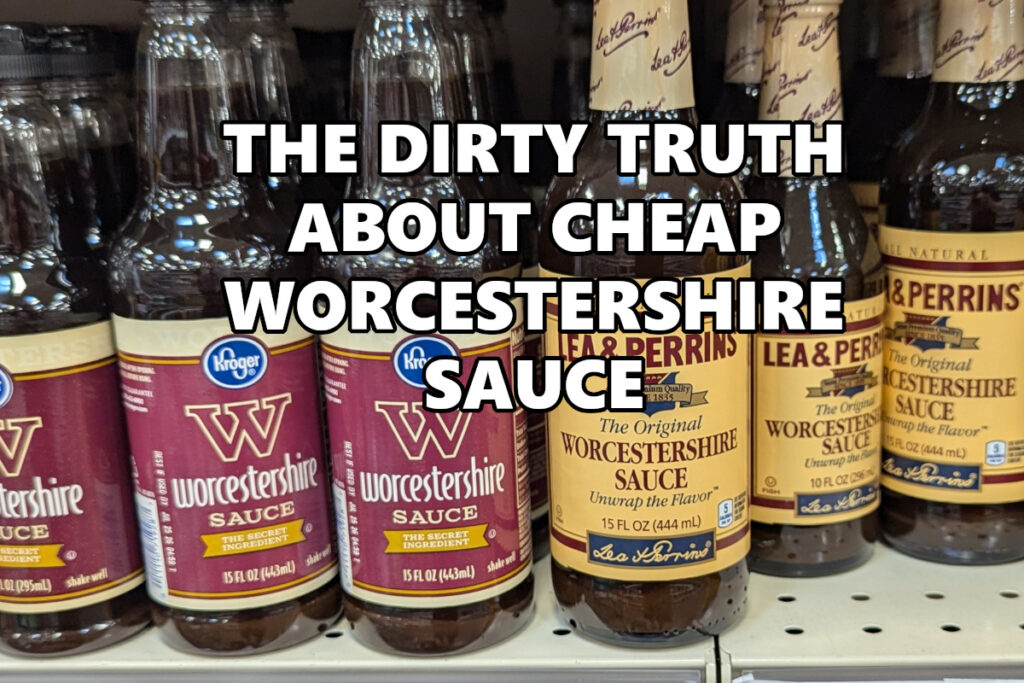
You’re standing in the condiment aisle, looking at two bottles of Worcestershire sauce. One costs 14 cents per ounce. The other? 60 cents per ounce. That’s more than four times the price.
Your hand naturally reaches for the cheaper Kroger brand. Makes sense, right? It’s the same thing.
Except it’s not even close.
I recently compared these two bottles side by side, and what I found shocked me. The price difference isn’t about fancy packaging or brand recognition. It’s about whether you’re buying real food or a chemistry experiment disguised as sauce.
Let me show you exactly what you’re getting when you cheap out on Worcestershire sauce, and why the more expensive option is actually the better deal.
The Price Breakdown: Cheap vs Quality
Kroger Worcestershire Sauce: 14 cents per ounce Lea & Perrins Worcestershire Sauce: 60 cents per ounce
That’s a 328% price difference. Sounds crazy to spend that much more on what looks like the same product, right?
Keep reading. You’ll change your mind.
The Ingredient Showdown: Real Food vs Fake Food
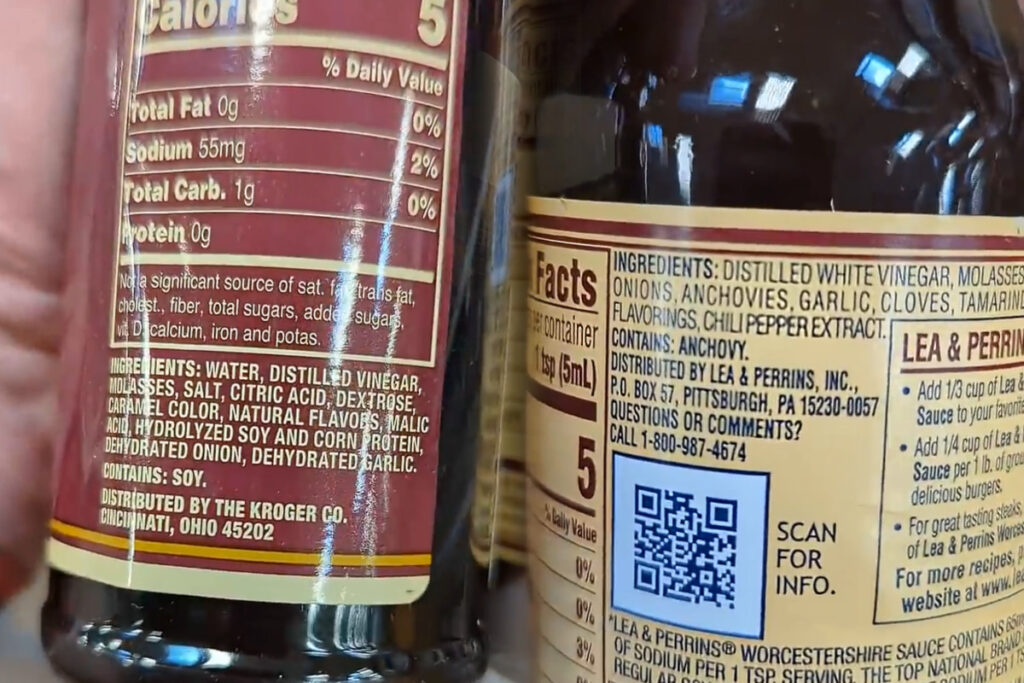
Here’s where things get interesting. Let’s look at what’s actually in these bottles.
Kroger Brand Worcestershire Sauce Ingredients:
- Water
- Distilled Vinegar
- Molasses
- Citric Acid
- Dextrose
- Caramel Color
- Natural Flavors (always dubious)
- Hydrolyzed Soy Protein
- Salt
- Corn Syrup
- Garlic Powder
- Spices
- Tamarind Extract
- Xanthan Gum
- Polysorbate 80
- Sodium Benzoate (preservative)
Lea & Perrins Worcestershire Sauce Ingredients:
- Distilled Vinegar
- Molasses
- Sugar
- Water
- Salt
- Onions
- Anchovies
- Garlic
- Cloves
- Tamarind Extract
- Natural Flavorings
- Chili Pepper Extract
Look at that second list. You can pronounce everything. You could buy everything at a regular grocery store. These are actual foods that have existed for centuries.
Now look at the first list again. See the difference?
Breaking Down the Bad Stuff: What’s Really in That Cheap Bottle
Let’s talk about some of the ingredients in that Kroger bottle that should make you think twice.
Hydrolyzed Soy Protein
This is where things get sketchy. Hydrolyzed soy protein is created by boiling soybeans in hydrochloric acid and then neutralizing the solution with sodium hydroxide (lye). The process breaks down the proteins into amino acids.
Sounds appetizing, right?
The problem isn’t just how it’s made. During the hydrolysis process, MSG (monosodium glutamate) is created as a byproduct. But because it occurs “naturally” during processing, manufacturers don’t have to list MSG on the label. They can just call it “hydrolyzed soy protein” or “natural flavors.”
If you’re trying to avoid MSG, you’re getting it anyway.
Caramel Color
Not the caramel you’re thinking of. This isn’t melted sugar. Industrial caramel color is made by heating sugars with ammonia and sulfites under high pressure.
The FDA recognizes four types of caramel coloring (Class I through IV). Class III and IV, which are commonly used in processed foods, contain compounds called 4-MEI (4-methylimidazole) and 2-MEI (2-methylimidazole).
The State of California has listed 4-MEI as a possible carcinogen. While the amounts in food are generally considered safe by the FDA, I’d rather not consume something created in a chemical process when there’s a perfectly good alternative that gets its color from actual molasses.
“Natural Flavors”
This is my favorite catch-all term that means absolutely nothing. “Natural flavors” can include over 100 different chemicals, all derived from something that was once natural (even if it barely resembles food anymore).
The FDA allows manufacturers to hide these ingredients under the umbrella term “natural flavors” to protect proprietary formulas. You have no idea what you’re actually eating.
Could be beaver anal glands (castoreum, commonly used as “natural vanilla flavoring”). Could be anything. You’ll never know.
Polysorbate 80
An emulsifier that keeps ingredients from separating. It’s made from sorbitol (a sugar alcohol) and oleic acid, processed with ethylene oxide (a known carcinogen).
Studies have linked polysorbate 80 to digestive issues, including changes in gut bacteria and increased inflammation in the intestinal lining. Some research suggests it may contribute to metabolic disorders and affect the body’s ability to absorb nutrients.
Is it in small amounts? Sure. But it’s in a lot of processed foods. Those small amounts add up when you’re consuming it regularly across multiple products.
Xanthan Gum
A thickening agent created by fermenting sugar with a bacteria called Xanthomonas campestris. While it’s generally recognized as safe, some people experience digestive issues including bloating, gas, and diarrhea.
Not everyone reacts poorly to it, but it’s another additive that serves a purely cosmetic purpose. It’s there to make cheap sauce look thicker and more premium than it actually is.
Are your guts torn up from eating fake foods?
Read this article on healing your guts NOW!
Why Real Ingredients Actually Matter
Here’s what Lea & Perrins uses instead of all that chemical nonsense:
Anchovies: Real fish that provide that savory, umami depth. This is what Worcestershire sauce is supposed to taste like. The Kroger version tries to fake this with hydrolyzed soy protein and “natural flavors.”
Real Onions and Garlic: Actual vegetables that add complexity and flavor. The cheap stuff uses garlic powder and whatever mystery compounds are hiding in those “natural flavors.”
Real Spices: Cloves and chili pepper extract instead of a mystery blend of “spices” that could be anything.
The Lea & Perrins formula has been around since 1837. It was created in Worcester, England (hence the name), and the recipe has barely changed because it works. They age the sauce in barrels for months to develop the complex flavors.
Kroger is trying to approximate that flavor profile using chemistry instead of time and real ingredients.
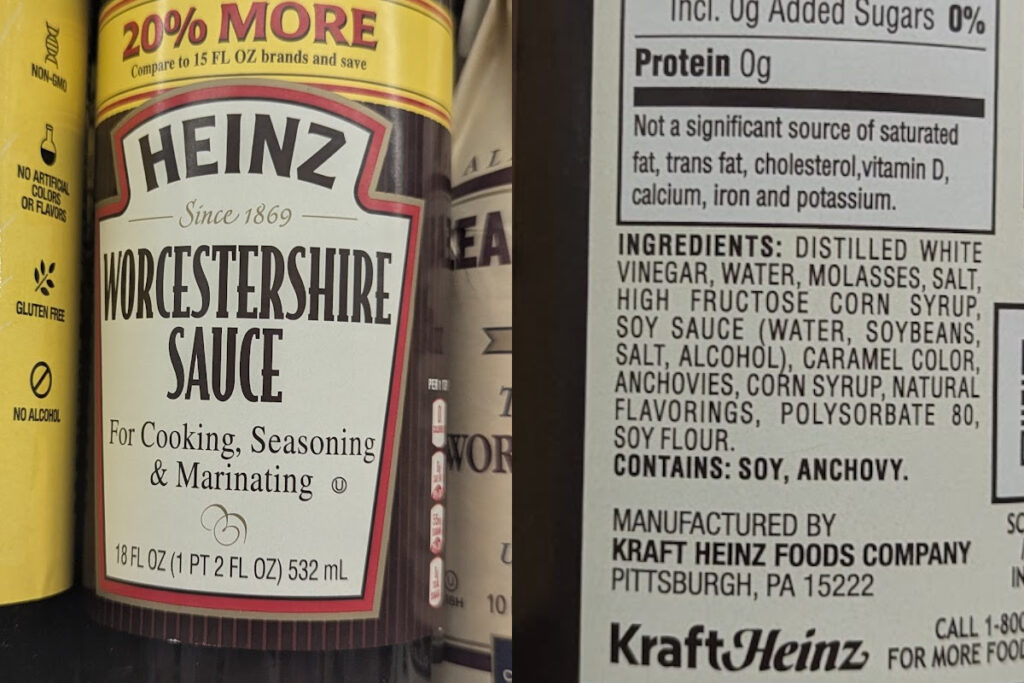
The Taste Test Reality
I’m not going to pretend they taste identical. They don’t.
Lea & Perrins has a deeper, more complex flavor with layers that develop on your palate. There’s a funkiness from the fermented anchovies, a subtle heat from real peppers, and a tangy sweetness that balances perfectly.
The Kroger brand tastes… flat. It hits the basic notes (salty, tangy, slightly sweet) but there’s no depth. It’s a one-dimensional approximation of what Worcestershire sauce should be.
If you’re drowning something in sauce, you might not notice. But if you’re using it properly (as an accent to enhance other flavors), the difference is night and day.
Unexpected Ways to Use Real Worcestershire Sauce
Most people only think of Worcestershire sauce for bloody marys and maybe marinating steak. You’re missing out.
Here are some places where a dash of real Worcestershire sauce makes a massive difference:
- Scrambled eggs: A few dashes before cooking adds serious depth
- Burger patties: Mix directly into the ground beef before forming patties
- Meatloaf: Essential ingredient that most people forget
- Chili: A secret weapon that enhances the meaty, savory notes
- Cheese toast: Drizzle on top of cheese before broiling
- Potato salad: Adds complexity to the dressing
- Deviled eggs: A dash in the yolk mixture takes them from good to great
- Beef stew: Deepens the broth without overpowering
- Grilled vegetables: Brush on zucchini, mushrooms, or eggplant before grilling
- Popcorn: Mix with melted butter for a savory kick
- Caesar salad dressing: The traditional recipe calls for it
- French onion soup: Enhances the caramelized onion flavor
- Roasted nuts: Toss with Worcestershire before roasting for a savory snack
- Gravy: A tablespoon adds richness to any pan gravy
- Fried rice: Better than soy sauce for adding umami depth
The key with Worcestershire is using it as a background flavor enhancer, not the star. A little goes a long way, which brings me to my next point.
Why “Expensive” Sauce Is Actually Cheaper
Let’s do the math.
A typical bottle of Lea & Perrins is 10 ounces and costs around $6. That bottle will last me 6-8 months because you use it by the dash, not by the cup.
That’s less than $1 per month for a condiment that dramatically improves dozens of dishes.
Meanwhile, the Kroger bottle costs $1.40 for 10 ounces. Seems like a great deal until you realize:
- You’re consuming chemical additives that may affect your health long-term
- The flavor is inferior, so you end up using more to get the same impact
- You’re supporting a food system that prioritizes cheap ingredients over quality
Is saving $4.60 per bottle really worth it when that bottle lasts half a year?
Put another way: Would you pay an extra 76 cents per month to avoid hydrolyzed soy protein, polysorbate 80, and mystery “natural flavors”?
I would. And I do.
The Real Cost of Fake Food
Here’s the thing nobody talks about: cheap processed food isn’t actually cheap.
You pay for it in other ways:
Health costs: Those chemical additives may contribute to inflammation, digestive issues, and metabolic problems. Your body has to process all that garbage, and it takes a toll.
Hidden costs: When you buy low-quality ingredients, you often need more of them to get good results. That cheap sauce doesn’t have the same punch, so you use twice as much.
Quality of life: Food that tastes better makes you enjoy cooking more. When you’re using real ingredients, even simple dishes become more satisfying.
The food industry has convinced us that paying more for quality is getting ripped off. They want you to think brand names are just marketing.
Sometimes they are. But in this case, you’re paying for fundamentally different products.
How to Spot Fake Food in the Grocery Store
This isn’t just about Worcestershire sauce. This is about everything you buy.
Here’s my rule: If the ingredient list includes more than 10 items, and more than half of them sound like they belong in a chemistry lab, put it back.
Red flags to watch for:
- Hydrolyzed anything (protein, vegetable protein, etc.)
- “Natural flavors” or “artificial flavors”
- Numbers (polysorbate 80, Yellow No. 5, etc.)
- Multiple preservatives (sodium benzoate, potassium sorbate, TBHQ)
- Partially hydrogenated oils
- High fructose corn syrup
- Cellulose (literally wood pulp)
- Ingredients you can’t pronounce
- Caramel color (especially in products that shouldn’t need coloring)
Green flags to look for:
- Short ingredient lists (under 10 items)
- Ingredients you recognize as actual food
- Ingredients you could theoretically buy yourself
- No chemical names or numbers
- Minimal or no preservatives (real food doesn’t last forever, and that’s okay)
The real food version might cost 2-4 times more, but you’re getting 2-4 times more actual nutrition and flavor. You’re not getting ripped off. You’re getting real food instead of an edible food-like product.
The Bottom Line: Read Every Label
I used to grab whatever was cheapest without thinking twice. Then I started actually reading ingredient labels, and I got pissed off.
The food industry is banking on you not paying attention. They’re counting on you to see “Worcestershire sauce” on two bottles and assume they’re basically the same thing.
They’re not.
One is fermented anchovies, vinegar, and spices aged in barrels. The other is water, chemicals, and a prayer that you won’t notice the difference.
The next time you’re shopping, flip the bottle over. Read what’s actually in it. Ask yourself: Is this real food, or is someone trying to sell me a science experiment?
Your body knows the difference, even if your wallet doesn’t want to admit it.
Buy the Lea & Perrins. Your taste buds, your gut, and your future self will thank you.
Frequently Asked Questions
Is Worcestershire sauce gluten-free?
Lea & Perrins Worcestershire sauce is NOT gluten-free. It contains malt vinegar, which is made from barley. However, Lea & Perrins makes a gluten-free version that uses distilled vinegar instead. Always check the label to be sure, as formulas can vary by country.
Can you substitute soy sauce for Worcestershire sauce?
Not really. While both provide umami (savory) flavor, they’re completely different products. Soy sauce is saltier and lacks the tangy, sweet, and fermented complexity of Worcestershire. You can use Worcestershire as a substitute for soy sauce in some recipes, but not the other way around.
Does Worcestershire sauce need to be refrigerated?
No. The high vinegar and salt content preserve it at room temperature. However, refrigerating it after opening will help maintain optimal flavor for longer. An unopened bottle can last several years. Once opened, it’s best used within 18 months for peak flavor.
Is there a vegetarian Worcestershire sauce?
Yes, several brands make vegetarian versions that replace the anchovies with soy sauce or mushrooms to mimic the umami flavor. Annie’s and Wizard’s are popular options. However, these will taste different from traditional Worcestershire and may contain some of the same processed ingredients as cheap brands, so read the labels carefully.
What’s the white stuff floating in my Worcestershire sauce?
That’s completely normal. It’s sediment from the aging process and the natural ingredients (particularly the anchovies and spices). Just shake the bottle before using. This actually indicates you bought real Worcestershire sauce. The heavily processed versions are filtered and stabilized to prevent any sediment.
Can I use Worcestershire sauce if I have a fish allergy?
No. Traditional Worcestershire sauce contains anchovies, which are fish. Even small amounts can trigger allergic reactions in people with fish allergies. Look for vegetarian versions instead, but verify they’re truly fish-free by reading the ingredient label and checking for allergen warnings.
Why does some Worcestershire sauce taste different in other countries?
Lea & Perrins formulas vary slightly by region due to different regulations and ingredient availability. The UK version uses malt vinegar (contains gluten), while the US version traditionally used distilled vinegar but now often includes malt vinegar too. Some countries have different sugar types or spice blends. This is why you should always read the label in your specific location.
How much Worcestershire sauce should I use in recipes?
Start with 1-2 teaspoons and adjust from there. Worcestershire is concentrated and punchy, you don’t need much. In a marinade for a pound of meat, use 1-2 tablespoons. In soups or stews, start with 1 tablespoon per pot and taste before adding more. Remember: you can always add more, but you can’t take it out once it’s in there.
Does Worcestershire sauce go bad?
It can, but it takes a long time. Signs of spoilage include mold (rare), an off smell (different from the normal pungent vinegar smell), or a significant change in color. If you see any of these signs, toss it. Most properly stored Worcestershire sauce will degrade in quality (lose flavor) rather than spoil. When in doubt, smell it. Your nose knows.